Notiz
FPGA
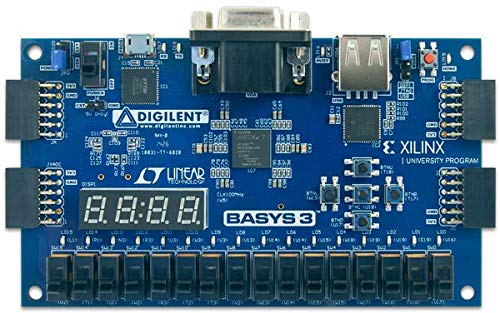
Based on the FPGA version and the device I am using currently:
- I am using Artix-7 FPGA (
xc7a35tcpg236-a(active)) and a 64-bit counter
-
CLB - Configurable Logic Block
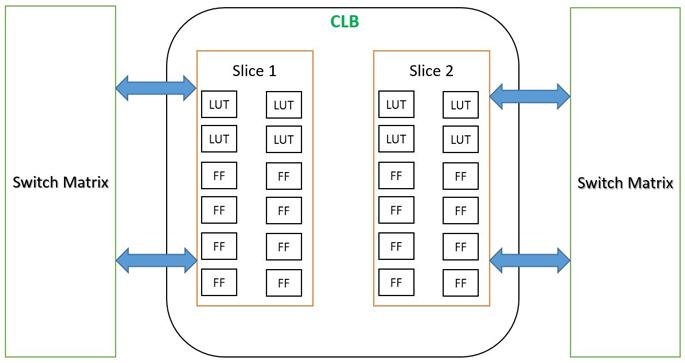
A CLB is a physical block inside an FPGA that contains resources for building digital circuits.
Think of it as a small workshop containing tools for processing and storing binary data.
-
Here, Artix-7 FPGA contains thousands of CLBs.
-
Each CLB contains two slices.
-
Vivado uses resources inside these CLBs to implement the VHDL design.
For example, when we write a counter in VHDL, Vivado uses CLB resources to implement its counting logic.
-
-
Slice - A smaller part of CLB: A slice is a subdivision of CLB containing configurable logic and storage resources.
In our current project for
Artix-7FPGA, one slice contains:- 4 LUTS
- 8 flip-flops
- 1 CARRY4 carry-chain block
- Additional multiplexers and connections.
In Vivado, we can see
SLICE_X10Y20, that means a physical slice at column X10 and row Y20.A CLB contains two slices, but the two slices do not necessarily have identical capabilities.
-
LUT - Look-Up Table
A LUT is a small programmable logic circuit that produces an output based on its inputs. Imagine you want to implement an AND gate:
     $[ Y=A\land B ]$  A LUT can store the following truth table:

 | A   | B   | Output Y |
 | --- | --- | -------- |
 | 0   | 0   | 0        |
 | 0   | 1   | 0        |
 | 1   | 0   | 0        |
 | 1   | 1   | 1        |
Instead of physically constructing a separate AND gate, the FPGA configures a LUT to produce these outputs.
Your Artix-7 uses 6-input LUTs, meaning one LUT can implement any Boolean function of up to six inputs with one output.
In your counter: LUTs help calculate the next counter value, including whether individual bits should change.
-
Flip-Flop - Stores one bit A flip-flop is a small circuit that remembers one bit (0 or 1).
Unlike a LUT, which calculates an output from current inputs, a flip-flop stores a value over time.
-
Carry Chain - Helps perform arithmetic quickly
A carry chain is a dedicated hardware path that makes arithmetic operations, such as addition, faster.
The most important distinction to remember:
-
LUT = Calculates
-
Flip-flop = Remembers
-
Carry chain = Speeds up arithmetic
-
Slice = Contains these resources
-
CLB = Contains slices